
What is a lead magnet?
A lead magnet is something genuinely useful that a business gives away in exchange for an email address. A template, a checklist, a calculator, a swipe file, a short guide. DigitalMarketer, who did more than anyone to popularise the term, defined it as "an irresistible bribe offering a specific chunk of value to a prospect in exchange for their contact information", which is blunt but right. The email is not the prize. It's the start of a relationship where you keep being useful until the person is ready to buy, or ready to send someone who is.
Why most lead magnets are s**t
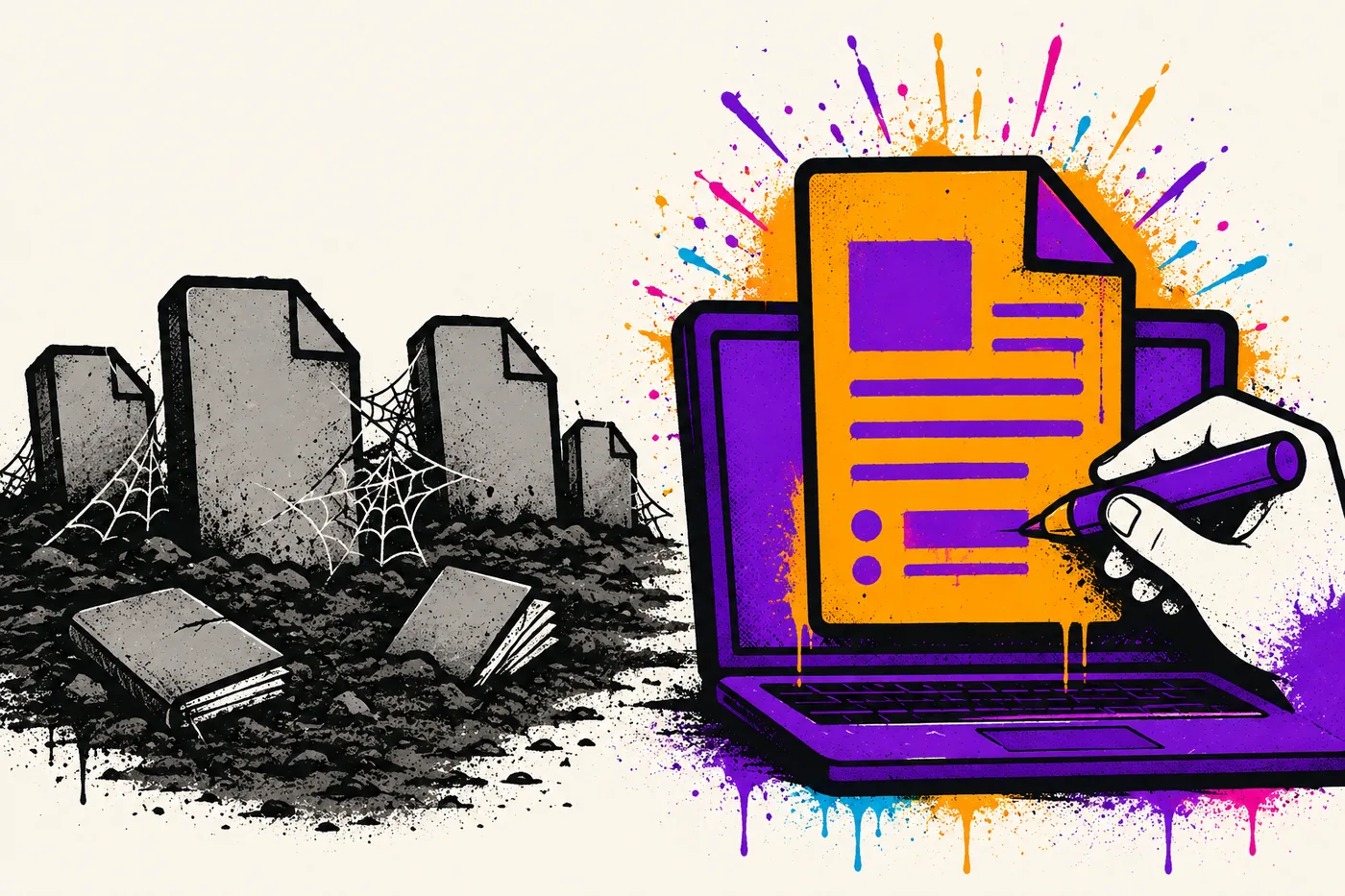
Because they don't do what they're supposed to do. A lead magnet has four jobs: build trust in you, move the reader a step further along their journey, diagnose or name a pain they've actually got, and help them fix one piece of a wider problem so they end up closer to fixing the whole thing. "The Ultimate Guide to Marketing" does none of those for anyone in particular, which is why the downloads folder is a graveyard.
You can see the category's thinness in its own statistics. The line "50% of marketers see higher conversion rates with lead magnets" appears on two of the top-ranking pages, sourced to two different secondary aggregators, neither of which points at any original research. The genre's most famous number, "35,859 leads in 60 days", is a self-reported claim from 2017 with a deliberately blurred screenshot and no funnel, traffic or follow-up detail attached. And the widely quoted "ebook conversion has dropped below 0.9%" couldn't be traced to the report it's attributed to. When a topic's evidence is that recycled, it usually means nobody ranking for it is actually doing the thing.
Here's the honest 2026 answer to "do lead magnets still work?": the mechanic is fine, the default format is dead. The largest vendor datasets show onsite capture rates rising year on year (Wisepops, across a billion popup views) and quiz completion holding steady across 80 million leads (Interact). What's tired is the generic ebook, and AI finished it off: generic is now free to produce, so it's worthless to receive. The same shift makes specific, useful tools cheap to build. That's the whole opportunity.
"A lead magnet is a filter, not a net. Write the title so the wrong people don't want it."
The filter, not the net
Twelve years in sales gave me one instinct about lead magnets that the software vendors never mention: the point isn't the most downloads, it's the right ones. A good magnet's title is a qualifying question. "Free marketing guide" catches everyone and qualifies no one. "The one-page brief that stops your marketing budget becoming a donation" only appeals to an owner about to spend money badly, which is precisely who I want to hear from. The tailoring happens on the landing page: the headline filters, the bullets confirm, and if you sell something, the form can carry a question or two that separates buyers from freebie-collectors.
It also means the research comes before the building. Using AI, the building is genuinely quick now: an evening. The time should go into finding out what your ideal customer is stuck on, in their own words (your inbox, your calls, the forums they moan in), breaking that into baby steps, and making the thing that fixes one step. If you can't name the person and the step, you're not ready to build.
The five formats worth an evening
Sized against the four spare hours a week you actually have, and each one with a live example on this site:
- The fillable template (one or two evening hours). Your process, written down, one box per step, filled in on the page and printable. Example: the Marketing Brief Template. Filters for people about to do the job.
- The checklist (about an hour). One recurring moment or deadline your customer faces, 8 to 15 items, done. A year-end checklist for company directors filters for exactly the people who'll need an accountant in the next 90 days.
- The calculator or working tool (an evening with AI). Give someone their own number and they'll screenshot it, send it to their partner, and come back. Example: the Pipeline Review Template, a working pipeline that saves in the browser, and the Pipeline Calculator.
- The swipe file (an evening). Real examples you're allowed to show, with the formulas behind them and copy buttons. Example: the Lead Magnet Swipe File, which dissects the other three.
- The prompt pack (an hour or two). The jobs your customer actually does, one prompt each. Example: the AI Prompt Pack.
Two honest notes on formats. First, quizzes and scorecards: from what I've seen building magnets in the day job, and in every vendor dataset, they convert best, because they give someone a result about themselves. Interact reports that 40% of people who start one of its quizzes hand over their email. Note the denominator: people who started, not people who saw the page. A scorecard is a weekend, not an evening, and it only works if the result genuinely diagnoses something. It's on my list. Second, the "it should be a lot of work" instinct: I had it too, and the instinct is half right. It should be a lot of value. That's not the same as a lot of pages.
Anatomy of a gate that earns the email
The best structural advice on the internet about this comes from Leadpages, and it's four lines: a headline that names the thing and its benefit, a picture of the deliverable, three to five bullets, one field and a benefit-led button. Here's how that looks with the receipts from this site's own gates:
- The headline names the thing and the outcome. "The sales pipeline template that tells you the truth." Keyword, then promise.
- A TL;DR does the persuading in plain English. Unbounce's data across 41,000 landing pages found pages written at a 5th-to-7th grade reading level converted at a median 11.1% versus 5.3% for college-level prose. Plain English isn't dumbing down; it's the single biggest conversion lever you control.
- One real thing is given away above the gate: a dissected example, a before-and-after, a prompt. Proof of quality, before you ask for trust.
- Four bullets, one field, a button that names the thing. "Send me the template", never "Submit". A gate body that answers the three silent objections in order: what happens now, what happens later, what's the catch.
- The reassurance line is the consent line. Next to the form, in plain words, what else the email signs you up for. More on why in a moment.
- Instant unlock plus inbox delivery, with a tag. The page opens immediately, the email arrives too, and the subscriber is tagged with what they wanted, so you can talk to them about it later instead of blasting everyone with everything.
All three of this site's gates, delivery emails included, are pulled apart line by line in the free Lead Magnet Swipe File, with the formulas behind every line and copy buttons on every block. Yours for an email.

Build one in an evening (with AI)
- Pick the person and the step (the research you already did). One customer, one baby step of their bigger problem.
- Interview yourself. Get an AI to ask you ten questions about how you'd solve that step for a client, then turn your answers into the first draft. (Prompts 01 and 10 in the Prompt Pack do this; prompt 17 brainstorms the magnet itself.)
- Make it usable, not readable. Fillable boxes, a table, a calculator, copy buttons. If the reader can't DO something with it in ten minutes, it's an article, not a magnet.
- Build the gate from the anatomy above. Write the reassurance line before the headline; if you can't say plainly what the email gets them, the offer isn't clean yet.
- Write the delivery email with the link as the second line, one genuinely useful tip, and an invitation to reply. Welcome and delivery emails are the most-opened email you will ever send (GetResponse's benchmark puts welcome-email opens at around 84% against a 36% all-email average on Mailchimp): put the value in them.
- Test the whole path yourself, on your phone, with a real inbox. The bit that goes wrong is never the bit you expected. (Mine was the embedded form rendering a giant default theme because I hadn't published the styled version. Ten minutes to fix, and only because I checked.)
The law bit, in plain English (UK GDPR and PECR)
This is where most small-business magnets quietly go wrong, so here it is properly. Two things are happening when someone types their email: you're delivering a thing they asked for, and you're hoping to email them again. UK law treats those separately. From the ICO's guide to PECR: "You must not send marketing emails or texts to individuals without specific consent. There is a limited exception for your own previous customers, often called the 'soft opt-in'."
Consent, under UK GDPR, has to be freely given, specific, informed and unambiguous: a clear affirmative action, no pre-ticked boxes, and, in the ICO's words, "separate from other things, such as terms and conditions". The line that matters most for lead magnets is in the ICO's direct marketing guidance: consent must not be required "as a condition of service unless it is necessary for that service". Receiving your newsletter is not necessary for delivering a PDF, so "enter your email to get the guide and agree to receive marketing" is exactly the bundle to avoid.
- The cleanest structure: an email field labelled for delivering the named resource, plus a separate, unticked checkbox that names your business, says it's email marketing, and links your privacy notice.
- The soft opt-in almost never covers a cold download. It applies to people who bought from you or actively negotiated to (asked for a quote, say). The ICO is explicit that it "does not apply to prospective customers or new contacts". Downloading a checklist isn't negotiating a purchase.
- B2B nuance: the PECR consent rule doesn't apply to corporate subscribers (limited companies, LLPs), but sole traders and some partnerships count as individuals, and UK GDPR fairness, transparency and the right to object still apply to everyone. "It's B2B" is not a free pass.
- Double opt-in isn't legally required, but it's good hygiene and it proves the affirmative action happened.
- Keep records: who consented, when, from which form, and the exact wording they saw.
For transparency about this site: the gates here use one email field and a plain-English line stating that the email also gets the daily letters, with a one-click unsubscribe in every email. That's specific and informed. The ICO's cleanest version is the separate checkbox, and I'd rather tell you that than pretend otherwise. This is guidance, not legal advice: if you're regulated, sell to consumers, or use bought data, ask a solicitor.
After the download: the bit that earns the email
The first email must contain the thing, or a link that works on a phone, so they definitely receive it. Then a short nurture that moves them towards the next useful thing. If you sell something, that's the next offer in its own funnel: one funnel per product, each one walking people down the journey rather than one list getting everything. If you're building an audience first, like this site, it's the next resource and the regular letters. Either way, the tag from the gate is how you know who wanted what.
Measure the second number, not the first. Downloads are vanity. What matters is what subscribers do in the ninety days after: open, reply, come back for the next thing, ask a question, refer someone. Buyers are more informed and more sceptical than they've ever been: in TrustRadius's 2026 research, 94% of B2B buyers say they fact-check what AI tells them, and in Redpoint's 2025 buyer survey the things that built trust in content were original research (70%) and expert opinion (64%), not volume. A magnet that carries your actual judgement, on a problem your actual customer has, is the whole game. Everything else is a PDF.
Sources: Unbounce Conversion Benchmark Report 2024 (464M visitors, 41,000+ pages; medians) · Wisepops popup benchmark reports 2025/2026 (vendor data) · Interact quiz benchmark (vendor data, quiz-starter denominator) · GetResponse 2024 and Mailchimp 2024 email benchmarks (vendor data, open rates inflated by Apple Mail Privacy Protection) · Demand Gen Report 2022 buyer survey · Redpoint "Content That Converts" 2025 · TrustRadius B2B Buying Disconnect 2026 · DigitalMarketer (2017) · ICO: Guide to PECR (electronic mail marketing), "How do we comply with the PECR electronic mail marketing rules?", "Plan direct marketing", "Business-to-business marketing", Direct Marketing Guidance (PDF) · Leadpages landing-page anatomy. Named as unverifiable and not used: the recycled "50% of marketers" figure, the "0.9% ebook conversion" claim, any universal "reciprocity" uplift. No conversion figures from this site's own magnets are claimed: it's pre-launch, and they'll be published when they exist.