
Start here or waste everything: who exactly are you for?
Before channels, before tools, before a single post or cold call: who is your ideal customer, and what do they actually get from you? Not "SMEs". A specific kind of business, with a specific pain, buying a specific outcome. If you market to everyone, you're marketing to no one, and every hour you spend on any channel is diluted before it starts.
Work it out properly: what your best customers have in common, what triggers them to look for help, what they're afraid of, what they're really buying (the benefit, never the feature: nobody buys bookkeeping, they buy Sunday evenings back and no brown envelopes from HMRC). Write it down once and every piece of marketing you ever do gets sharper. The Marketing Brief Template walks you through exactly this, and the payoff is that your content starts landing with the people it's for, because they recognise themselves in it.
How to get B2B leads: the honest channel menu
The best UK data we have on where small firms actually get customers is the British Chambers of Commerce and Intuit's 2025 survey of 1,558 business leaders (93% of them SMEs). The channels firms use to win customers: referrals and word of mouth 78%, social media 63%, their website 54%, networking 44%, SEO 37%, email 35%, Google Ads 18%, and a marketing agency just 11%. One caveat the survey itself makes: that measures who USES each channel, not which channel makes the most money. But the shape of it matches everything I saw in 12 years of selling to small firms.
Here's the menu, with the candour the vendor guides can't afford:
- Referrals: the channel you already have and don't work. Trusted recommendations are the most believed form of marketing there is (Nielsen's global research puts trust in personal recommendations at 92%, far above any advertising), and the peer-reviewed Wharton bank study found referred customers were worth at least 16% more and 18% less likely to leave. Yet hardly anyone asks: one industry survey put it at just 11% of salespeople. The fix is a system, not a plea. More below.
- Your website and being findable. Second-order but vital: referred buyers Google you before they call, and when a problem turns urgent, buyers search for a specialist. Clear service pages, real proof, an obvious next step. This is also where AI search is quietly changing the game: open, genuinely useful pages get quoted by the tools buyers now ask first.
- LinkedIn and organic content. The best fit for a founder-led firm, because people buy from people: even the agencies admit founder-voice content beats vendor content. It's also how you stay remembered by the roughly 95% of your market that isn't buying this quarter (the Ehrenberg-Bass 95:5 rule of thumb). It costs consistency, not cash.
- Cold outreach. It still works, but only narrow and personal. I spent years doing it at industrial volume on a dialler: call after call, bought data, daily targets. It books meetings at a volume no owner has spare (large studies put average cold email replies at 0.45% and cold-call connects around 5%). The owner's version is different: ten genuinely researched approaches a week to businesses you can demonstrably help, opening with something true about THEM. That, unlike the spray, gets replies.
- Paid ads. Legitimate accelerant IF you know who you're for and your page converts. Money instead of time. Do it after the foundations, not instead of them.
- Networking and events. Used by 44% of UK firms and underrated by people who hate rooms. It feeds the referral engine: familiarity is what recommendations grow on.
And the candour bit: I've never sold outbound to accountants, and I've never seen an accountancy firm win work by cold calling. For a trust-heavy profession I'd put everything into referrals, visible expertise and being findable. The right menu depends on YOUR buyer. Anyone prescribing a channel before asking who you sell to is selling the channel, not the outcome.
"If you market to everyone, you're marketing to no one."
The one-channel rule
Here's the capacity truth every "34 lead generation strategies" listicle politely ignores: you have maybe four hours a week for this. That's not a strategy problem, it's arithmetic. An owner can run ONE channel properly, two at the absolute most, and one channel fed every single week will beat five channels fed whenever you remember. The practitioners' forums are full of honest breakdowns that land the same place: a year of trying everything, and one or two channels produced nearly all the revenue.
So choose like this: where do your buyers already look when the pain gets urgent, and what can you sustain weekly without hating your life? If you're spending money you don't have: my budget-zero prescription is cold calling plus organic content, because both cost only nerve and consistency. If you have money but no hours: paid traffic to a page that converts, plus the referral system. Everything else waits until the first channel is humming.
The referral system nobody builds
Since referrals are the biggest channel in the UK data and the least worked, here's the system, and it's four sentences long. After every clearly good outcome (project done, problem solved, nice email received), ask for an introduction, not a favour: name the KIND of business you're best for, and make it forwardable ("if you know another [firm like theirs] wrestling with [the pain], I'd love an intro; feel free to forward this"). Thank people fast and properly. Track who introduces, what converts, and what those clients are worth: the research says referred customers stay longer and spend more, so treat your introducers like the growth channel they are.
Qualify like you've done it for 12 years
The fastest way to feel busy while going broke is treating every name as a lead. Qualification is where lead generation becomes revenue, and it's three questions. Is there a pain you can genuinely fix, in their words, not yours? Is there urgency: do they want it fixed NOW, or is this a someday conversation? And is there budget: can they actually pay for the fix? Two of three missing means it's not a deal. It might be a future deal, which is what your nurture list is for.
Two field-tested additions. First, don't pitch on first contact. The job of a first conversation is to find out whether a pain exists, and you can't listen while you're pitching. When I was booking appointments on the phones, the calls that converted were the ones where the owner did the talking and I did the benefit translation at the end. Second, the earliest tell of a real buyer is engagement: how enthused they are, whether they'll keep talking, whether they ask questions back. Politeness is not interest. Enthusiasm is.
One thing those years of qualifying calls taught me about small businesses, by the way: ask an owner about their marketing and the honest answer, over and over, was "we've rarely done it" or "we half-arse it". Your competitors are not the polished few. They're the silent many. Showing up consistently is a genuine edge precisely because almost nobody does it.
"Politeness is not interest. Enthusiasm is."

Follow-up: where leads actually die (and the fake stats to ignore)
You've probably read that "80% of sales take five follow-ups but 44% of salespeople give up after one". Here's the thing: those numbers are folklore. The evidence audit I ran for this guide traced the famous "five follow-ups" statistic back to its origin: a 1942 survey of fewer than 40 people from a Long Island sales association, with no published methodology. The 44% and 48% claims trace to nothing verifiable at all. They've been recycled through a thousand sales blogs because they're useful, not because they're true.
The real, current numbers are still on persistence's side, just honest about it. RAIN Group's study of 489 sellers (covering $4.2 billion in purchases) found it takes around 8 direct touches to earn a first meeting, with top performers doing it in 5. In my experience the modern figure for a full journey is more like a dozen touches, because buyers are better informed and rule people out fast. Crucially, touches are mixed formats: a call, an email, a LinkedIn comment, a piece of your content they saw, something genuinely useful you sent. It all tallies. What doesn't tally is "just checking in" seven times.
Two more evidence-backed follow-up habits. Speed: the MIT/InsideSales lead response research found the odds of actually reaching a web lead were 100 times higher when called within five minutes versus half an hour, and their 2021 follow-up across 30 million contact attempts found 77% of leads never got any response at all. When an enquiry lands, a fast human acknowledgement naming the next step beats a perfect reply tomorrow. And exits: when someone's gone quiet after your full mix of touches, park them into nurture (they keep seeing your content until the pain gets urgent, and they come back to whoever they remember) rather than deleting them or haunting them.
This is exactly what the free Pipeline Review Template runs for you: the one-page pipeline, the weekly 15-minute honesty ritual, and the kill/park criteria that stop deals rotting. Yours for an email.
The pipeline that catches it all
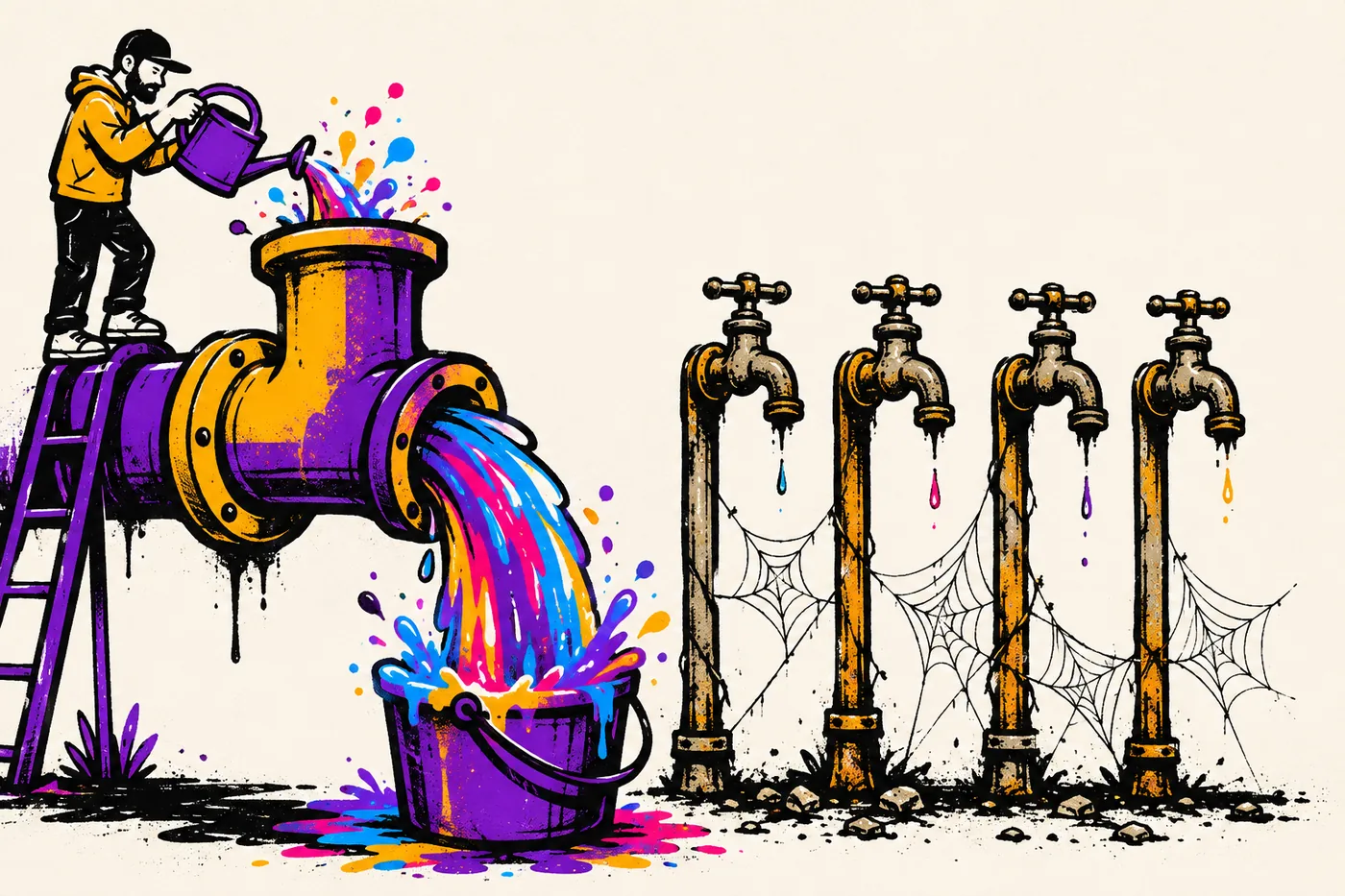
Leads without a pipeline behind them are water into sand. Mine is six stages in plain English: Leads (not yet contacted), Contacted (attempts logged with dates), Discovery call, Proposal, Closed won/lost, and Nurture for the real-but-not-now conversations. No probability percentages: a next step with a date is the only forecast a small pipeline needs. Then fifteen defended minutes a week asking each deal the honest questions: when did THEY last respond, what's the dated next step, and does it still pass pain-urgency-budget?
This isn't just hygiene. Harvard Business Review's research with Vantage Point Performance found B2B companies that combined a clearly defined sales process with regular, trained pipeline attention grew 28% faster than those that didn't (it's an association, not a guarantee, but it points the right way). In a small firm there's no sales manager to run that discipline. You're the sales manager. Fifteen minutes on Friday is the job.
Measure leads and sales, not likes
The scoreboard for all of this is short: enquiries by source, meetings booked, proposals out, deals won, and revenue by source. Traffic, followers and impressions exist only to explain those numbers, never to replace them. If a channel sends you traffic that never becomes conversations, the channel isn't working, whatever the graph looks like. Track where every enquiry actually came from (ask them: "how did you hear about us?" remains the best attribution tool a small firm owns) and double down where the customers come from, not where the applause does.
Sources: British Chambers of Commerce / Intuit, "The Turning Point for SMEs" (2025, n=1,558) · Nielsen Global Trust in Advertising (28,000+ respondents) · Schmitt, Skiera & Van den Bulte, "Referral Programs and Customer Value", Journal of Marketing (Wharton/Goethe bank study, ~10,000 customers) · OutboundEngine (11% referral-ask figure) · RAIN Group prospecting research (489 sellers) · MIT/InsideSales.com Lead Response Management studies (original + 2021, ~30m contact attempts) · Belkins 2025 cold email dataset (7.5m emails) · Gong cold-call dataset (reported) · Ehrenberg-Bass Institute (the 95:5 heuristic, John Dawes) · Jordan & Kelly, Harvard Business Review (2015) with Vantage Point Performance. Where a famous number failed the audit (the 1942 follow-up folklore, "referrals convert 3-5x", MEDDIC win-rate percentages), it's been binned or flagged rather than repeated. UK sales-cycle-length data has no solid primary source, so no number is claimed.