
What AI is actually good at (and what it's rubbish at)
Most owners I speak to have typed a few things into ChatGPT, got something mediocre back, and quietly filed AI under "overhyped". Fair. But that first impression is a prompting problem, not a capability problem, and it's worth knowing where the real edges are, because they've been measured.
The best study we have is a randomised trial with 758 BCG consultants, now peer-reviewed in Organization Science (2026). On tasks inside AI's competence (writing, ideas, analysis, persuasion), people using AI finished 12% more tasks, 25% faster, at meaningfully higher quality, and the weakest performers gained most. That last bit matters if marketing isn't your trade: AI levels you up furthest exactly where you're least confident.
But on a task just outside AI's competence (a strategy problem mixing hard numbers with messy human context), AI users were 19 percentage points MORE likely to get it wrong than people working alone. The output sounded confident either way. The researchers called this the "jagged frontier": AI is brilliant and useless at tasks that look almost identical, and it never warns you which side of the line you're on.
So, translated for a working owner:
- Genuinely good at: first drafts of anything written, turning your rambles into posts, summarising research, repurposing one piece into five, mining your reviews for themes, tidying and reading simple data, and interviewing YOU to get what's in your head onto the page.
- Rubbish at: knowing your customers (it's never met them), sounding like you without samples, strategy calls that depend on context it doesn't have, maths, current facts without a search tool, and knowing when it's wrong. It will be confidently, fluently wrong instead.
And I'll say the honest bit the vendor guides won't: it hallucinates all the time. At work we produce SEO reports with AI in the loop, and it'll sometimes pad sections with more than was asked for, or get a stat flat wrong. Which is why nothing goes out until a human has checked the numbers. Not because the tools are bad, but because that's the job now: the machine drafts, you verify. Small firms have clocked this, by the way: 92% of UK small business owners now say they're concerned about AI risks, up from 73% in 2023 (FSB, November 2025), with hallucination the specific worry for over half. The concern is correct. The conclusion ("so I won't use it") isn't. You just need a system that assumes the errors.
"The machine drafts, you verify. That's not a limitation of the system. That IS the system."
The one rule that changes everything: context
If you take a single sentence from this whole guide, take this one: the quality of what AI gives you is set by the context you give it. Not the magic words, not the "secret prompt", not which tool. Context.
Anthropic (the company behind Claude) puts it like this in their own guidance: treat the model like a brilliant new employee who knows nothing about your business. You wouldn't hand a new starter a Post-it saying "do a LinkedIn post" and walk off. You'd tell them who we sell to, what they care about, how we talk, what we're trying to achieve. The machine needs the induction too.

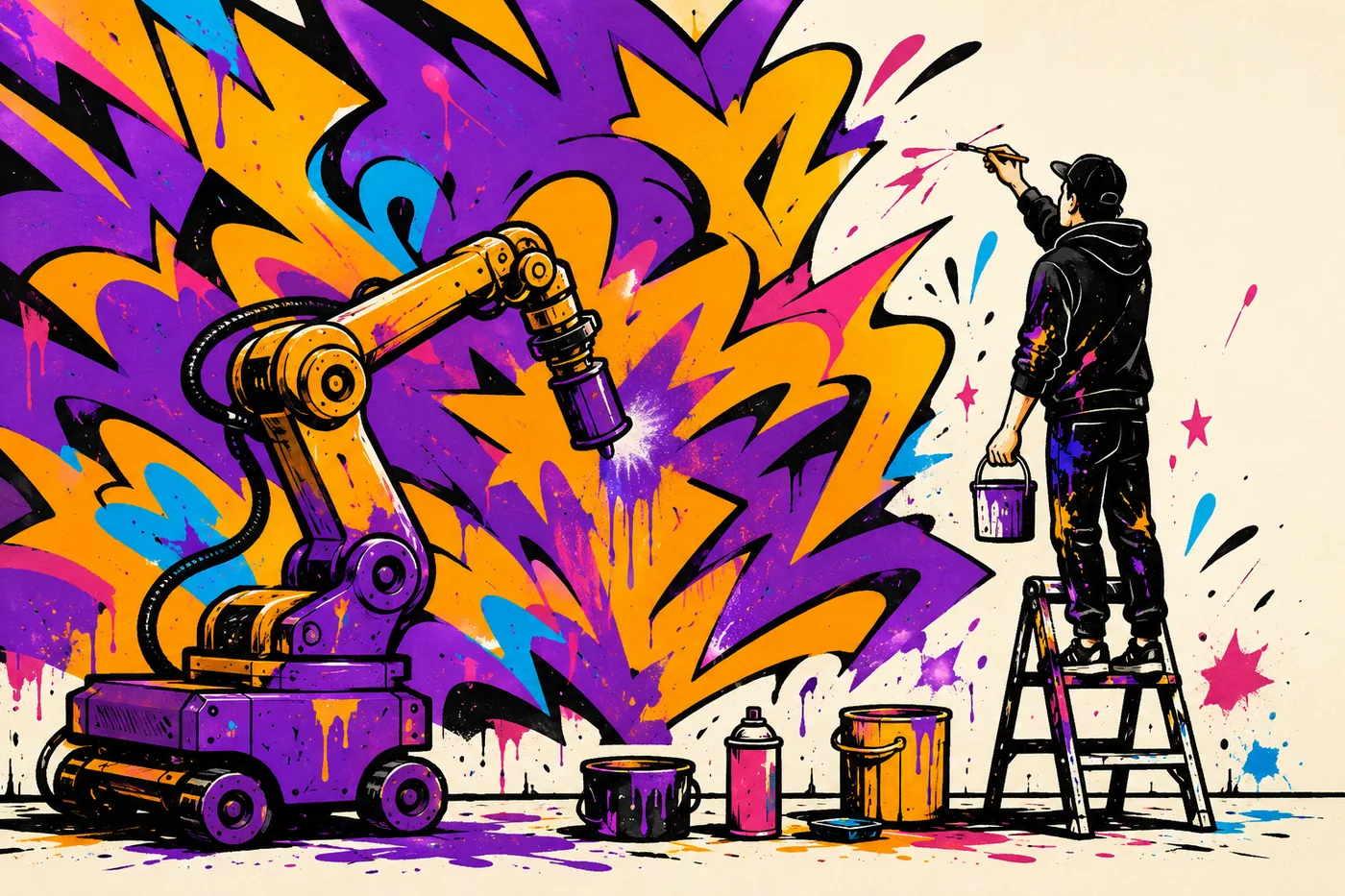
I learned this properly when I was designing this site. Early attempts, where I just described the look I wanted, came back as generic templates. It just didn't pop. So I changed approach: I fed it the style I actually meant, real graffiti and street art references, examples I liked, and told it to go and find more. Different machine, overnight. Same model, same me. The only thing that changed was the context.
The practical version of this rule is a document I'd tell every owner to make: a business brief. One page. Who you're for, what they're really buying, how you sound, what proof you have, what a good month looks like in numbers. Write it once, paste it into every AI chat you ever start. Ten minutes of setup that upgrades every output forever. (Prompt 01 in the free prompt pack builds it for you by interviewing you.)
Automate nothing until it bores you
Here's the discipline that separates people getting real value from AI from people generating plausible mush, and you won't find it in any tool vendor's guide: do the job manually first. Every time.
- Do the job by hand once or twice. Write this month's newsletter yourself. Feel where the effort actually goes.
- Write the process down. Every step, in order, so simply that someone else could follow it. If you can't write it down, you don't understand it yet, and neither will the machine.
- Hand steps to the AI one at a time. Keep the judgement steps for yourself.
- Only then let it run. When the process is documented and boring, it's ready to be delegated. Not before.
This is exactly how I write content at work now. The process, roughly: keyword research is already done and sitting in a spreadsheet. Take the next keyword, search it, save what's actually ranking. Research the topic properly for the nuance the top results miss. Layer in our own expertise, the stuff only a practitioner would know. Then draft, with AI in harness at every step. It took a few runs to build, and now it's documented so simply I can more or less let it run, with a human check on every fact before anything ships. The article you're reading came off a version of that same production line, and I'd happily show anyone the process doc, because the process isn't the moat. Doing it is.
Notice what the AI didn't do there: it didn't decide what to write about, and it didn't approve the result. The thinking stayed human. The typing got delegated.
"If you can't write the process down, you don't understand it yet. And neither will the machine."
The five jobs to start with
Don't start with "AI strategy". Start with a job that's currently eating an evening. These five are where the hours come back fastest, and marketing is already the number one thing UK small businesses use AI for (named by 72% of business AI adopters in the government's 2025 adoption research), so you'd be in good company:
- Answer enquiries faster and better. Paste the enquiry and your business brief; get a warm, specific reply with a clear next step. Edit, send. Minutes, not an hour of drafting anxiety, and speed wins work.
- The monthly email you keep not sending. Keep rough notes through the month, hand them over, get a letter back. Your list stops going cold.
- This week's LinkedIn post, from a ramble. Talk into your phone for ten minutes about what customers get wrong; the transcript becomes a month of posts in your voice. This is genuinely how the daily letters on this site get made.
- Repurpose one thing into five. One good article becomes a post, an email, three shorts and a video script. The pros squeeze everything; owners publish once and move on.
- Mine your reviews. Paste every review you've got; get back the exact phrases customers use and the three things they actually value. That's your website copy, written by the people you want more of.
Every one of those jobs has a ready-made prompt in the free AI Prompt Pack: 20 context-rich prompts for real marketing jobs, built on Anthropic's and OpenAI's own guidance. Yours for an email.
The 80/90-10 rule: you finish it, always
You're never going to get the final edition from a machine. It'll get you 80 to 90 percent of the way there, and the temptation, especially at 9pm, is to ship that. Don't. The last 10 percent is where the value lives: the true story only you know, the line phrased how you'd actually say it, the claim you soften because you know your market, the stat you check because you've seen the machine invent one before.
This isn't me being precious. It's what the professionals actually do. In HubSpot's State of AI research, 55% of marketers who use AI use it for writing, but only 4% let it write whole pieces, only 7% publish anything unedited, and 56% make significant edits. The people using this stuff most are exactly the people who trust it least with the final word.
There's a hard commercial reason too: your customers can smell it. Only 28% of UK consumers say they trust AI-generated content (Emplifi, 2026), and in Harris Poll data, trust in an ad drops from roughly seven in ten for human-made to two in ten for fully AI-generated. Nobody's suspicious of AI-assisted work that a human finished, because they can't tell. They're suspicious of the obviously machine-made mush. The edit is what keeps you on the right side of that line.
Editing AI output is a skill of its own, and it's mostly deletion: cut the "delve"s and "in today's fast-paced landscape"s, cut the third rephrasing of the same point, replace the generic example with the real one from your last client. Then read it aloud. If you wouldn't say it across a desk, it's not done.
Tools: what to actually pay for
Shorter section than you'd expect, because the honest answer is boring: pick one of the big three chat assistants and learn it properly.
- Claude is my daily driver and the one I'd hand a beginner: easy, clean interface, excellent writer. I've been on a paid plan since the start because I use it constantly.
- ChatGPT is every bit as capable, and if you already know it, stay. Switching logos buys you nothing.
- Gemini is fine too, and effectively free if you live in Google Workspace.
Free tiers are fine for finding out whether you'll actually use it. The moment it's daily, pay the £15 to £20 a month: better models, more capacity, and it's the single best marketing subscription a small firm can buy in 2026. For context, in LOCALiQ's UK survey a fifth of small businesses spend under £1,000 a YEAR on all their marketing. Twenty quid a month for a tireless drafting assistant is not where your budget dies.
What about the 30-tool listicles? Ignore them. Almost every "AI marketing tool" is one of the same underlying models wearing a nicer shirt and a bigger invoice. The next real level up isn't more tools, it's connection: the big assistants can now plug into your other systems (your spreadsheets, your email platform, your data) and work across them. Worth knowing it exists; not worth touching until the basic habit is paying for itself.
Will Google punish AI content? (And the new question behind it)
The fear that keeps owners from using AI for their website is out of date. Google's position, stated in their own spam policies, is method-neutral: using AI isn't the offence, publishing scaled low-value content is, "no matter how it's created". A human content farm and an AI content farm get the same treatment. What the March 2024 crackdown and everything since actually punished was mass-produced pages that help nobody.
The ranking data backs this up. Across studies of hundreds of thousands of pages (Ahrefs, Semrush, 2025), AI-assisted content ranks essentially as well as human content, with one telling exception: purely AI-generated pages very rarely hold the number one spot. Which is the 80/90-10 rule again, enforced by the algorithm: drafted by machine, finished by human ranks; unedited mush doesn't.
The newer, more interesting question: what happens when your customers ask ChatGPT or Perplexity instead of Google? AI assistants cite sources, and research on what they cite is young but consistent on a few things: clear, well-structured pages with real statistics and quotable lines get cited more (the one peer-reviewed study on this measured visibility lifts of up to 40% from exactly those elements), independent and genuinely useful content beats brand brochures, and your site has to be technically open to AI crawlers at all. Several of the big vendors ranking for this topic literally block AI systems from reading their pages. A small, open, honest site can outrun them there. That's not theory: it's the plan for this one.
What it all costs, honestly
| Item | Cost | Notes |
|---|---|---|
| One chat assistant, paid plan | £15–£20/mo | Claude, ChatGPT or Gemini. The only essential. |
| Your business brief | One evening | The context document. Highest ROI hour in this guide. |
| Learning the five jobs | A few evenings | One job at a time, manual first, then delegate. |
| Time back, once it's habit | ~2+ hrs/week | The most defensible research figure (St. Louis Fed, regular users). Daily users report more. Vendor "10x" claims: no. |
That time-saved number deserves the honesty flag: the best academic evidence (a US Federal Reserve survey) puts it at roughly 2.2 hours a week for people who use AI regularly, with a third of daily users saving over 4 hours. Not the "20 hours a week!" of the LinkedIn goons, but real, and for an owner doing marketing in the evenings, two-plus hours a week is most of the marketing time you currently have.
Sources: Dell'Acqua et al., Organization Science (2026), the BCG "jagged frontier" RCT · FSB small business AI survey (Nov 2025) · DSIT AI Adoption Research / GOV.UK (2025) · HubSpot State of AI · Emplifi (2026) · Harris Poll UK (2026) · Google Search spam policies and guidance on AI-generated content · Ahrefs and Semrush ranking studies (2025) · Aggarwal et al., "GEO: Generative Engine Optimization" (KDD 2024) · St. Louis Fed / NBER generative AI time-use research (2024–25) · LOCALiQ UK small business marketing survey (2026). Where UK data doesn't exist (there's no solid UK study of owner hours spent on marketing, for instance), I've said so rather than inventing a number.